Bright Crockery Days, The Poetry of Robert Gray
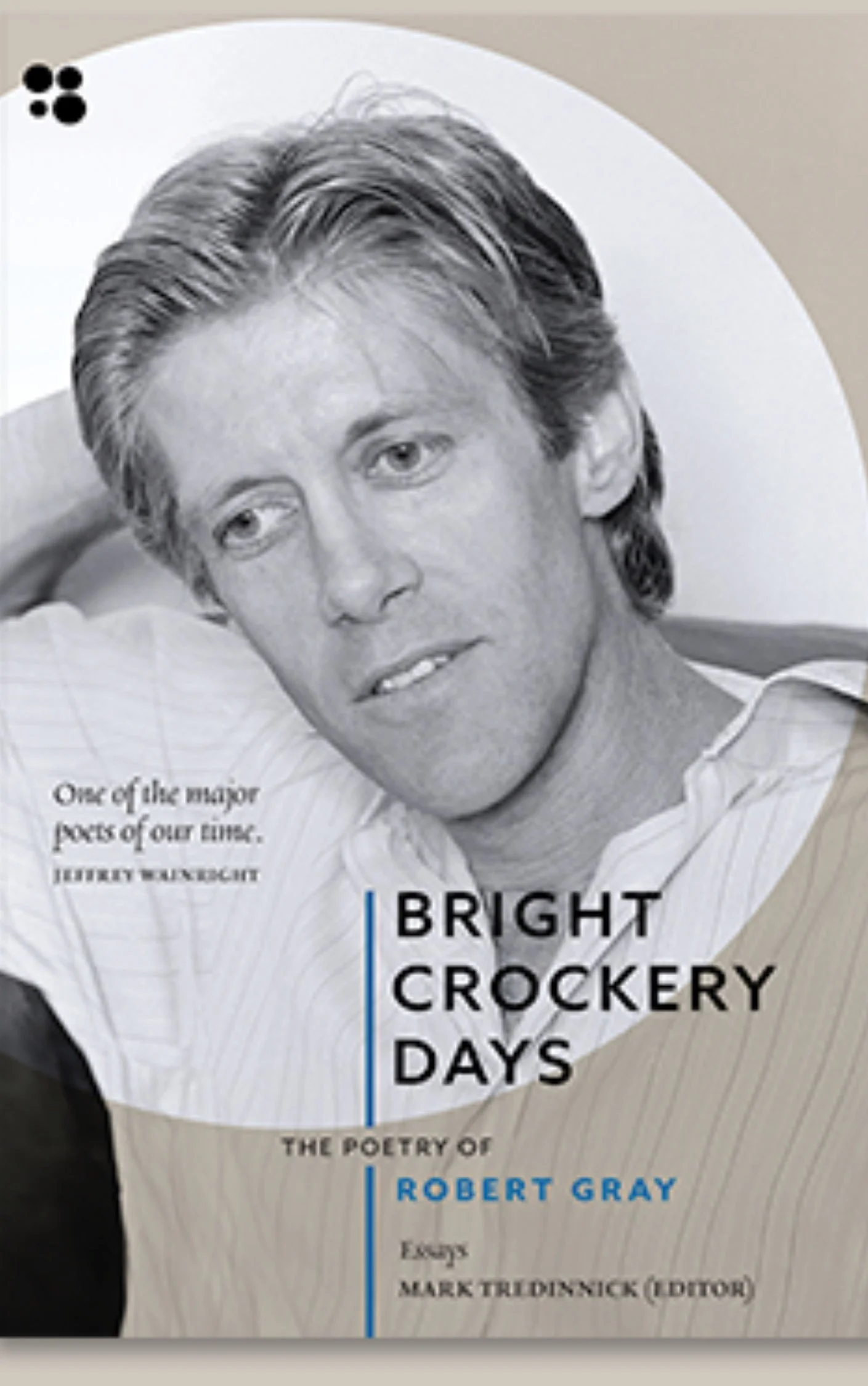
In the Rank Grass:
Description as Transcendence
By Todd Turner
Be patient that I address you in a poem
—William Carlos Williams
Ask the fact for the form
—Ralph Waldo Emerson
A collection of poetry often weaves back and forth between its subjects, and occasionally you'll find a smaller poem on one theme propping up a larger one. A shorter poem may anticipate a longer one on the same subject, a poem of more ranging inquiry: perhaps the earlier poem left its business unfinished. Sometimes, a small personal poem leaves its or the poet’s thinking beyond range, or perhaps when written, it’s too unsettling for a poet to engage with across an expansive form.
In Robert Gray's 1978 collection, Grass Script, such a concurrence exists between the poems “The Name” and “Poem to My Father.” The former reads as a sketch for the second, a larger work. “The Name,” which can be read as a poem about the poet's father, is an unrhymed poem of seven couplets. In its entirety: “He is a man getting on / in years, / who listens to racing, / stays at the pub / when he finishes work / about 2.00. / Or he'll come straight back / sometimes / to the room. I can hear / he's lying down / again, / to use the name / of a woman / who has forgotten him.”
The last line in the poem is open-ended (which woman, why has she forgotten him?), and we’re left to consider the things unsaid. This approach can appease or haunt a poet. I see the process as something of a dare the poet makes with themselves: can I leave it here, or could I add fuel to the fire? Clearly a strong emotional need underpins the poem.
Scrutiny is a vital component of poetry. Attesting to facts and bearing witness to particulars, in particular, those in the life one leads, are the pillars on which poetry stands. But how should a poem do its looking, and from where should it take its stance? In the preface of Robert Gray's memoir, The Land I Came Through Last, are these lines:
It seems to me that memory must be as we find it, pragmatically: something that can usually be relied upon. To deny this, in principle, is to deny there is a distinction between fantasy and empirical fact. A writer can only hope to create a sense of his subjects by accumulating their gestures; he has to trust that within his encircling imagery, if it is insistent enough, the dead will appear or a moment like a glimmer on the waves.
“Poem to My Father” begins with a salutation, followed by a proclamation to the deceased and immediately an undertow of irony swells within the language:
Dear father, you were buried
in perfect summer weather.
As the poem unfolds, we quickly learn of a perplexingly difficult and cantankerous man. “Such a day / you would sit outdoors / and put your bad leg up / in its slipper, / and pretend not to like it there: / too crowded / on the porch / with the pot plants, / or too shady / or too hot.” What powers the poem is the absorbing clarity of the depictions—and the strains, compressions and releases in the motion of each line:
you would call out
to my mother and sister
and make them run;
you'd have your lunch brought
on a tray, with doilies
and frangipani,
presented
for you to fault.
The poem is arranged in groups of three lines, with stepped indentation, a form devised by William Carlos Williams, a way he found to resolve the conflict between form and freedom in verse.
Notable early examples of this form are Williams's poems “The Sparrow (To My Father)” from Journey to Love (1955) and “To Daphne and Virginia” from The Desert Music (1954), which contains the line “Be patient I address you in a poem.” In “Poem to My Father,” there is a the stress of each triadic line parallels the gaps between the words, which give life to the poem; as Williams puts it, “the attenuated power which draws perhaps many broken things into a dance by giving them thus a full being.” “To ask the fact for the form,” as Emerson suggested, is the dance that Williams alludes to here. And finding the right form for a poem can liberate the poet to engage with their subject more freely, and it seems that this form of Williams’s found for Robert a way to write his father:
What went wrong
when you were young? It was nothing exceptional
that I can find.
On first reading the poem, over twenty-odd years ago now, I recall the excitement of being struck by the high-octane release at each line break and how freely the poem engages its truth. “Poem to My Father” does what good writing should: it makes you forget that you’re reading. For me, the confessional mode in poetry responds to the inherent human needto speak, and the power of this poem lies in the poet's self-granted permission to do so, under a strong emotional need. I sense that, given the sensitivity of familial matters, Gray has endured a self-imposed denial of certain truths, or facts, perhaps to keep the peace. Beneath the apparent ease of the narrative, throughout the poem, evidence of the withholding of “facts” is mirrored in the pressure of its release, as though the long-denied tension, looming like an undercurrent or tide, has emerged “like a glimmer on the waves.” Perhaps this is how our innermost selves deal with things we forbid ourselves to acknowledge, until we allow an underlying truth to emerge and illuminate:
So, you will become now
in your children's lives,
sometimes,
just the half-conscious, troubling
sense of something
we have forgotten to do,
or to bring
along with us,
if anything wants to remind us
of you.
You have gone
as if you were an illusion.
To traverse inward through language requires an abiding focus. The making of a poem is a demanding and exhilarating process of discovery, an inward traverse. Imagery, composition and thought develop in the making of a poem by the poet’s working a certain transformative element into the lines. One device for achieving transformation, the “glimmer”—often criticised or overlooked—is description. W.S. Di Piero remarked that “[g]ood descriptive poems are like perfumes made tactile.” When description homes in on memory with precision, something surprising may occur: the given imagery can open up into symbol and metaphor.
Transcendence is the purpose, or the hope, of penetrating deeper into language; description does not merely describe. Chosen, spoken and laid out as Robert Gray does, description becomes tension and release, dissonance and harmony, a music of recollection. Through the tumult of accumulative memory “Poem to My Father” steps into its closing stanza, and in the courage of its human testimony we witness poetry’s power to inspirit, to confront life, to seize it—and let it go: